Sicily's breathtaking landscapes and rich history are undeniable, but its position on a complex tectonic boundary means that seismic activity is a serious consideration for any property owner. Understanding and addressing earthquake risk is not just a matter of compliance; it's a crucial investment in the safety of your home and family. This guide provides a comprehensive overview of seismic retrofitting in Sicily, covering the regulations, intervention types, costs, and financial incentives available to help you secure your property.
Recent seismic events across Italy have underscored the importance of preventative structural measures. For homeowners in Sicily, particularly in the higher-risk eastern regions, proactively strengthening a property against potential earthquakes is one of the most important investments you can make. This process, known as seismic retrofitting (or adeguamento sismico), involves upgrading a building's structural system to make it more resistant to the ground shaking and lateral forces that occur during a seismic event.
Terra Nostra Costruzioni has extensive experience in seismic analysis and retrofitting projects across Sicily. We combine modern engineering techniques with a deep respect for traditional building methods to ensure your home is not only safer but also retains its unique character. From initial vulnerability assessments to the implementation of advanced solutions like Fibre-Reinforced Polymers (FRP) and base isolation, our team is equipped to guide you through every step of the process.
Understanding Seismic Risk in Sicily: Zones and Regulations
Italy classifies its territory into four seismic zones, based on the probability and intensity of expected earthquakes. The classification is critical as it dictates the specific building codes and anti-seismic design standards that must be followed.
- Zone 1: The highest-risk zone, where catastrophic earthquakes are most likely. This includes parts of Messina, Catania, and the surrounding provinces.
- Zone 2: High-risk zone. A significant portion of eastern and central Sicily falls into this category, including major cities like Palermo and Siracusa.
- Zone 3: Medium-risk zone. This covers much of western Sicily.
- Zone 4: The lowest-risk zone, with a very low probability of significant seismic events.
The majority of Sicily is classified as either Zone 1 or Zone 2, making seismic retrofitting a priority for most property owners. The area around Mount Etna, near Catania, is particularly complex due to the interplay of tectonic and volcanic seismicity.
The NTC 2018 Regulations
All new construction and significant structural renovations in Italy must adhere to the Norme Tecniche per le Costruzioni 2018 (NTC 2018). These technical standards provide a detailed framework for structural design, with a strong emphasis on anti-seismic performance. For existing buildings, the NTC 2018 outlines the requirements for seismic vulnerability assessments and the design of retrofitting interventions.
The core principle of the NTC 2018 is to ensure the protection of human life, with secondary objectives of preventing building collapse and limiting economic damage. The regulations require a qualified structural engineer to perform a detailed analysis of your property to determine its current seismic capacity and identify its structural weaknesses. Based on this analysis, a targeted retrofitting plan is developed.
| Seismic Zone | Hazard Level | Peak Ground Acceleration (PGA) | Typical Sicilian Provinces Affected (Partial List) |
|---|---|---|---|
| Zone 1 | High | > 0.25g | Messina, Reggio Calabria (Strait of Messina), parts of Catania |
| Zone 2 | Medium-High | 0.15g – 0.25g | Catania, Siracusa, Ragusa, Palermo, Agrigento |
| Zone 3 | Medium-Low | 0.05g – 0.15g | Trapani, Caltanissetta, parts of Palermo |
| Zone 4 | Low | < 0.05g | Small islands like Pantelleria, Lampedusa |
Note: This table is illustrative. The precise seismic zone for any given property must be confirmed via official municipal documentation.
Common Seismic Retrofitting Interventions
Once a structural analysis is complete, several types of interventions can be implemented to improve a building's seismic performance. The choice of technique depends on the building's construction type (e.g., masonry, reinforced concrete), its specific vulnerabilities, and the budget.
1. Fibre-Reinforced Polymers (FRP)
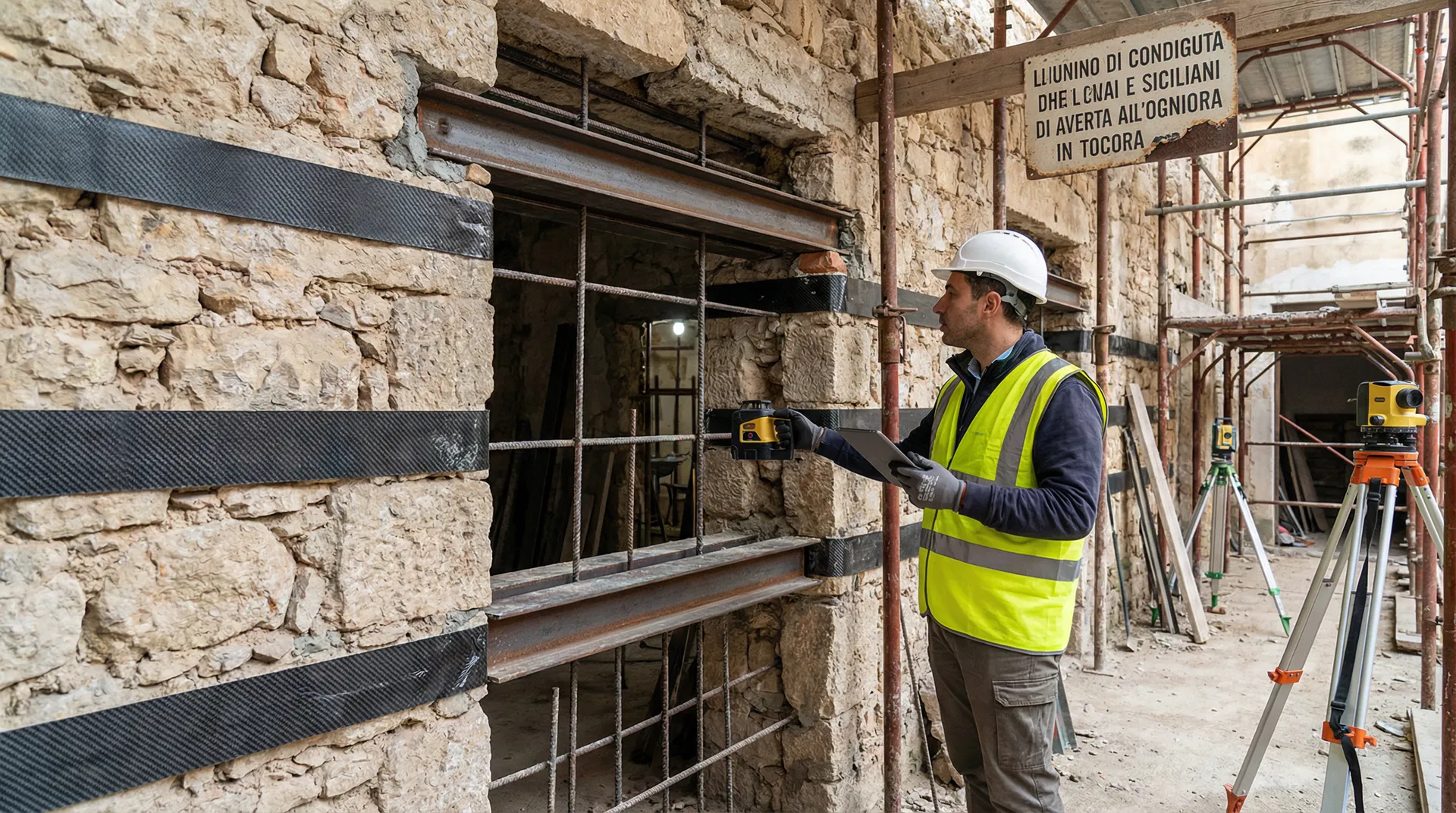
FRP composites are a modern and increasingly popular solution for reinforcing existing structures. These materials, which consist of high-strength fibres (like carbon, glass, or aramid) embedded in a polymer matrix, are lightweight, incredibly strong, and resistant to corrosion. They are applied to walls, beams, and columns like a high-tech wallpaper, significantly increasing their capacity to resist tensile and shear forces without adding significant mass to the structure—a key advantage in seismic design.
2. Steel Frame Reinforcement
This traditional method involves adding steel elements to the existing structure. This can include:
- Steel Bracing: Adding diagonal steel braces to create rigid frames that can resist lateral forces.
- Steel Jacketing: Encasing existing concrete columns or beams in steel plates to increase their strength and ductility.
- Ring Beams: Installing steel or reinforced concrete beams at the top of masonry walls to tie the structure together and ensure it acts as a single unit during an earthquake.
Steel interventions are highly effective but can be more invasive and architecturally disruptive than FRP applications.
3. Base Isolation
Base isolation is one of the most advanced and effective seismic protection technologies available. It involves decoupling the building from its foundations by installing flexible bearings or sliders. During an earthquake, these isolators absorb the vast majority of the ground's movement, allowing the building above to remain almost stationary. While highly effective, base isolation is also the most complex and expensive retrofitting strategy, typically reserved for critical buildings (like hospitals) or high-value historic properties.
| Intervention Type | Typical Cost per sq. m. (EUR) | Pros | Cons |
|---|---|---|---|
| FRP Strengthening | €150 - €400 | Lightweight, minimally invasive, fast installation, high strength | Higher material cost, requires specialised labour |
| Steel Frame/Bracing | €200 - €500 | High strength and ductility, well-understood technique | Invasive, can be architecturally disruptive, adds weight |
| Reinforced Concrete Jacketing | €250 - €600 | Increases strength and stiffness, fire resistant | Very invasive, adds significant weight and size to elements |
| Base Isolation | €500 - €1,000+ | Highest level of seismic protection, protects contents | Very high cost, complex installation, not suitable for all sites |
Disclaimer: These costs are estimates for illustrative purposes. The actual cost of a seismic retrofit project can vary significantly based on the building's condition, location, and the specific interventions required. For an accurate quote, please request a free cost estimate.
Financial Incentives: The Sismabonus
The Italian government offers significant tax incentives to encourage property owners to undertake seismic retrofitting work. The Sismabonus is a tax deduction on the expenses incurred for certified anti-seismic interventions on properties located in seismic Zones 1, 2, and 3.
The standard deduction is 50% of the expenses, up to a maximum expenditure of €96,000 per property unit. However, the deduction increases if the intervention leads to a certified reduction in the building's seismic risk class:
- 70% deduction for a reduction of one seismic risk class.
- 80% deduction for a reduction of two seismic risk classes.
For condominiums, the deductions are even higher, reaching 75% and 85% respectively. The Sismabonus is a powerful tool that can make a life-saving investment far more affordable. It can often be combined with other incentives like the Bonus Ristrutturazione for general renovation works, further reducing the overall financial burden. Navigating the paperwork for these bonuses can be complex, but our team at Terra Nostra Costruzioni can manage the entire process on your behalf.
The Catania & Mount Etna Area
Properties in the province of Catania and on the slopes of Mount Etna face a unique dual risk from both tectonic earthquakes and volcanic tremors. The volcanic soil and the prevalence of buildings constructed with local volcanic stone require specialised knowledge. Retrofitting in this area often involves addressing the specific ways that historic masonry structures respond to high-frequency vibrations. Techniques like improving connections between walls and floors and reinforcing vaulted ceilings are common priorities.
Frequently Asked Questions (FAQ)
How do I know if my property needs a seismic retrofit?
A qualified structural engineer must perform a seismic vulnerability assessment. This involves analysing the original construction plans, inspecting the property, and performing structural calculations to determine its capacity to withstand an earthquake as defined by the NTC 2018 for its specific location.
How long does a seismic retrofitting project take?
The duration depends entirely on the scale and complexity of the interventions. Minor reinforcements might take a few weeks, while a comprehensive project involving steel frames or foundation work could take several months. A clear timeline will be established after the initial engineering analysis.
Are building permits required for seismic retrofitting?
Yes. Seismic retrofitting is a major structural intervention that requires a formal building permit (such as a SCIA or Permesso di Costruire) to be filed with the local municipality. The project must be designed and overseen by a qualified engineer.
Can I live in my house during the retrofitting work?
This depends on the nature of the work. Minimally invasive techniques like FRP application may allow for partial occupancy. However, more extensive work, such as adding steel frames or jacketing columns, will likely require the property to be vacated for safety reasons.
Secure Your Sicilian Home
Investing in seismic retrofitting is a profound commitment to the safety and longevity of your property in Sicily. While the prospect can seem daunting, the combination of modern engineering solutions and substantial government incentives makes it more achievable than ever. By understanding the risks and taking proactive steps, you can protect your home and ensure it stands strong for generations to come.
If you are considering a structural renovation or are concerned about the seismic safety of your Sicilian property, contact Terra Nostra Costruzioni today. We offer comprehensive consultations, from initial vulnerability assessments to the execution of state-of-the-art retrofitting projects. Let us help you build a safer future. Contact us for a no-obligation consultation.
Ready to Start Your Project?
Contact Terra Nostra Costruzioni for a free consultation. We provide bilingual project management for renovation projects across Sicily.
Ask AI About This Topic
Get instant AI-powered answers about Structural Work
These links open external AI platforms with a pre-filled question about this topic.